
A Practical Comparison for Link Builders, Agencies, and SaaS Founders
Getting a backlink published is one thing. Making sure it stays live is another.
If you're a link builder, you probably know how the process works. You identify a relevant website, negotiate with the publisher, agree on an anchor text and destination URL, and eventually get the backlink published.
You verify the placement, add it to your report, and move on to the next one.
But what happens three months later?
The publisher might update the article and remove your backlink. Your dofollow link could become nofollow. The anchor text might change, or the page itself might disappear.
Unless someone checks those links regularly, you might never notice.
This becomes particularly important when you're managing dozens or hundreds of backlinks across multiple campaigns.
For SaaS founders, there's another concern: How do you know the backlinks you've paid an agency or freelancer to acquire are still live?
Most agencies provide reports when backlinks go live. But ongoing verification isn't necessarily part of the agreement.
That's where backlink monitoring tools come in.
However, not every tool approaches backlink monitoring the same way. Some specialize in checking acquired backlinks, while others provide backlink monitoring as part of a broader SEO platform.
In this article, we'll compare five options based on what actually matters when you're responsible for acquiring, managing, and maintaining backlinks.
What Should a Good Backlink Monitoring Tool Actually Do?
Before comparing tools, it's worth understanding what backlink monitoring should involve.
Most comparisons focus on features such as backlink discovery, Domain Rating, competitor analysis, and referring domains.
These are useful for SEO, but they don't necessarily answer the questions a link builder needs answered.
Suppose you acquired 50 backlinks last month. You already know which websites published them, their anchor texts, and their destination URLs. You don't necessarily need another tool to discover those backlinks. You need something that checks whether those 50 placements are still intact.
1. Regular Backlink Verification
A backlink monitoring tool should revisit acquired placements automatically. If a publisher removes your backlink today, you shouldn't have to wait several weeks to discover it. Daily monitoring provides a practical balance between detection speed and resource usage. However, it's important to distinguish between monitoring frequency and notification speed. A tool advertising real-time alerts might send a notification immediately after detecting a change. That doesn't necessarily mean it checks every backlink continuously. For example, if a backlink is checked once every 24 hours, a removal could remain undetected until the next scheduled check. There's nothing inherently wrong with daily monitoring. The important thing is understanding how frequently verification actually happens.
2. Accurate Handling of Missing Backlinks
This is arguably the most important capability. Imagine a publisher's website returns an HTTP 403 response when an automated crawler attempts to access it. Does that mean your backlink has disappeared? No. The website might be blocking automated traffic through Cloudflare or another security service. Similarly, a temporary server error or timeout doesn't prove that the backlink has been removed. A reliable monitoring workflow should distinguish between a confirmed missing backlink and a page that couldn't be verified.
3. Anchor Text and Link Attribute Monitoring
A backlink can remain present while its characteristics change. For example, you might negotiate a placement using the anchor text “project management softwareâ€. A few months later, the publisher edits the article and replaces it with your company name. The backlink still exists, but the agreed placement has changed. The same applies when a link's attributes change from dofollow to nofollow or sponsored. These changes can materially affect the value of the backlink, especially when the anchor text or link attributes were part of the agreed placement.
4. Notifications and Change History
Nobody wants to open a backlink monitoring dashboard every morning just to check whether something happened. A useful tool should notify you when meaningful changes are detected. It should also preserve historical information. Knowing that a backlink is currently missing is useful. Knowing when it was last verified live, when the problem was first detected, and whether it has disappeared before is considerably more helpful.
5. Campaign and Client Organization
For an individual SaaS founder monitoring 30 backlinks, a simple list might be sufficient. For an agency managing 15 clients and hundreds of placements, organization becomes important. Ideally, you should be able to separate backlinks by client, project, publisher, or campaign. Tracking acquisition costs can also be valuable when you're responsible for managing a link-building budget.
Best Backlink Monitoring Tools in 2026: Quick Comparison
| Tool | Best for | Monitoring approach | Starting paid price |
|---|---|---|---|
| Backlink Vigil | Dedicated monitoring of acquired backlinks | Daily checks with multi-step verification + change alerts | $20/month |
| Backlink Monitor | Backlink tracking and management | Backlink monitoring with change alerts | $9.99/month |
| Linkody | Monitoring combined with SEO metrics | Backlink status updates every 24 hours | $14.90/month |
| BacklinkMonitoring.ai | Monitoring and link recovery | Daily checks on paid plans | $29/month |
| Ahrefs & Semrush | Comprehensive backlink research | Database-driven backlink analysis and monitoring | Varies by subscription |
Prices and publicly documented features checked in October 2026. Monitoring approaches differ, and this table should not be interpreted as an accuracy ranking.
1. Backlink Vigil - Best for Dedicated Backlink Monitoring
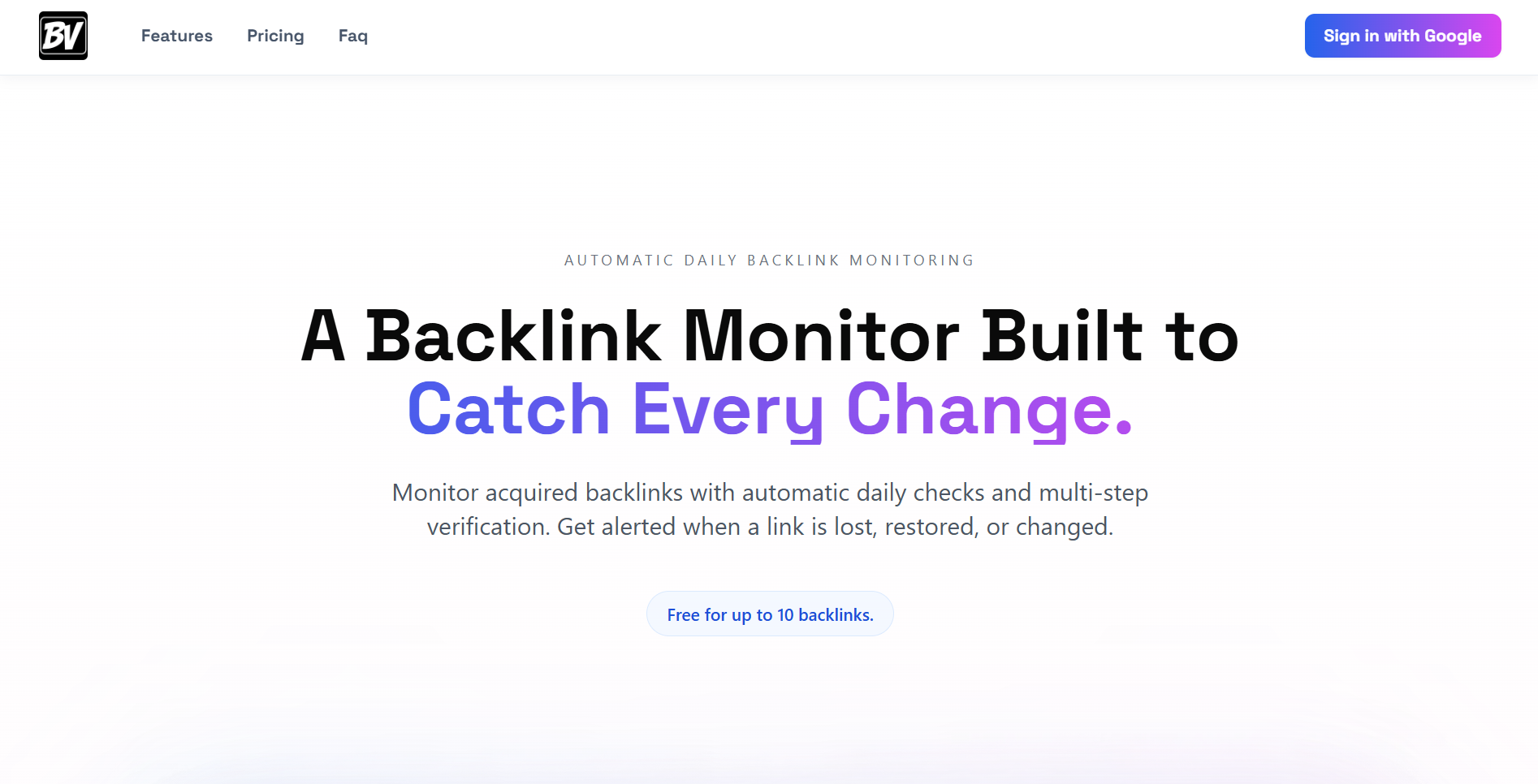
Best for: Link builders, link-building agencies, SaaS founders, and businesses monitoring backlinks they've already acquired.
Pricing: Free for up to 10 backlinks; Pro costs $20/month.
Backlink Vigil is a dedicated backlink monitoring tool designed around a straightforward requirement: checking whether the backlinks you've acquired remain live and unchanged.
Unlike broader SEO platforms, it doesn't attempt to provide keyword research, competitor analysis, or backlink prospecting. Its focus is on monitoring known placements.
You add the page containing your backlink and the URL it should point to. Backlink Vigil then checks the placement automatically every day.
It monitors whether the backlink is present, whether the anchor text has changed, and whether its link attributes or placement details have been modified.
What Makes Backlink Vigil Different?
One of Backlink Vigil's main strengths is how it approaches backlink verification.
Checking whether a backlink exists sounds simple. In practice, it isn't always straightforward.
Some publisher websites use Cloudflare, JavaScript rendering, bot protection, or other mechanisms that can interfere with automated crawlers.
A basic HTTP request might fail even when the backlink is perfectly accessible through a normal browser.
Backlink Vigil uses a multi-step verification process to handle these situations.
Its checking workflow can use standard HTTP requests, browser-based rendering, and an additional crawling service when necessary.
The objective is to avoid treating every unsuccessful request as evidence that a backlink has disappeared.
When a page cannot be reliably verified, Backlink Vigil can distinguish that situation from a confirmed missing link.
This distinction matters when you're managing paid placements.
A failed crawl shouldn't automatically become a lost-backlink notification.
Of course, no monitoring tool can guarantee access to every website. Some pages may remain inaccessible despite multiple verification attempts.
The important difference is acknowledging that uncertainty rather than assuming the backlink has been removed.
Monitoring More Than Link Status
Backlink Vigil doesn't stop at identifying whether a backlink is live or missing.
It also tracks changes to the placement itself.
For example, suppose you acquired a backlink with these details: Linking page: Publisher's blog article; Destination URL: Your SaaS product page; Anchor text: AI customer support software; Link attribute: Dofollow; Placement: Within the article body.
Three weeks later, the publisher updates the article. Your backlink remains live, but its anchor changes to your brand name.
Backlink Vigil can detect the change and preserve the previous and updated information in its link history.
The same applies to changes in link attributes and surrounding placement context.
This is particularly useful for agencies that negotiate specific anchors and placements with publishers.
Built for Link-Building Workflows
Another useful aspect is campaign organization.
Backlink Vigil allows users to organize backlinks into separate projects. For agencies, these projects can represent different clients. For SaaS companies, they might represent different products or campaigns.
Users can also record publisher or vendor information, backlink acquisition costs, and campaign months.
This makes it possible to monitor placements while keeping track of where they came from and how much was spent acquiring them.
For example, an agency managing 200 backlinks across five SaaS clients can organize the placements by project and review their status without maintaining separate monitoring spreadsheets.
Backlink Vigil also supports email and Slack notifications, including project-specific email recipients.
This allows relevant team members or stakeholders to receive updates when monitored backlinks change.
Backlink Change History
Backlink Vigil maintains a history of monitoring events.
Rather than simply displaying a backlink's current status, it can show when the link was first monitored and what changes have been detected since.
For example: September 1: Backlink added and verified live. September 12: Anchor text changed. September 20: Backlink confirmed missing. September 22: Backlink restored.
This history provides context when discussing placement issues with publishers, freelancers, or clients.
It also helps distinguish a one-time problem from a recurring issue.
Pros
· Dedicated specifically to acquired-backlink monitoring.
· Automatic daily backlink checks.
· Multi-step verification to reduce false loss alerts.
· Distinguishes unverifiable pages from confirmed missing links.
· Tracks anchor text, link attributes, and placement changes.
· Detailed backlink change history.
· Unlimited backlinks and projects on Pro.
· Vendor, acquisition cost, and campaign tracking.
· Email and Slack notifications.
· Project-specific notification recipients.
· Free plan for monitoring up to 10 backlinks.
Cons
· Doesn't offer competitor backlink research.
· No built-in backlink prospecting or outreach functionality.
· Doesn't provide comprehensive SEO authority metrics.
· Not intended to replace an all-in-one SEO platform.
Our Verdict
Backlink Vigil is a strong fit for users whose primary requirement is monitoring backlinks they've already acquired. Its combination of daily checks, multi-step verification, change history, and campaign organization makes it particularly relevant to link builders and agencies managing paid placements. For SaaS founders working with external link-building providers, it also offers a straightforward way to independently monitor delivered backlinks. However, if you need competitor research, backlink discovery, or extensive SEO analytics, you'll still need another platform.
2. Backlink Monitor - Best for Structured Backlink Tracking and Management
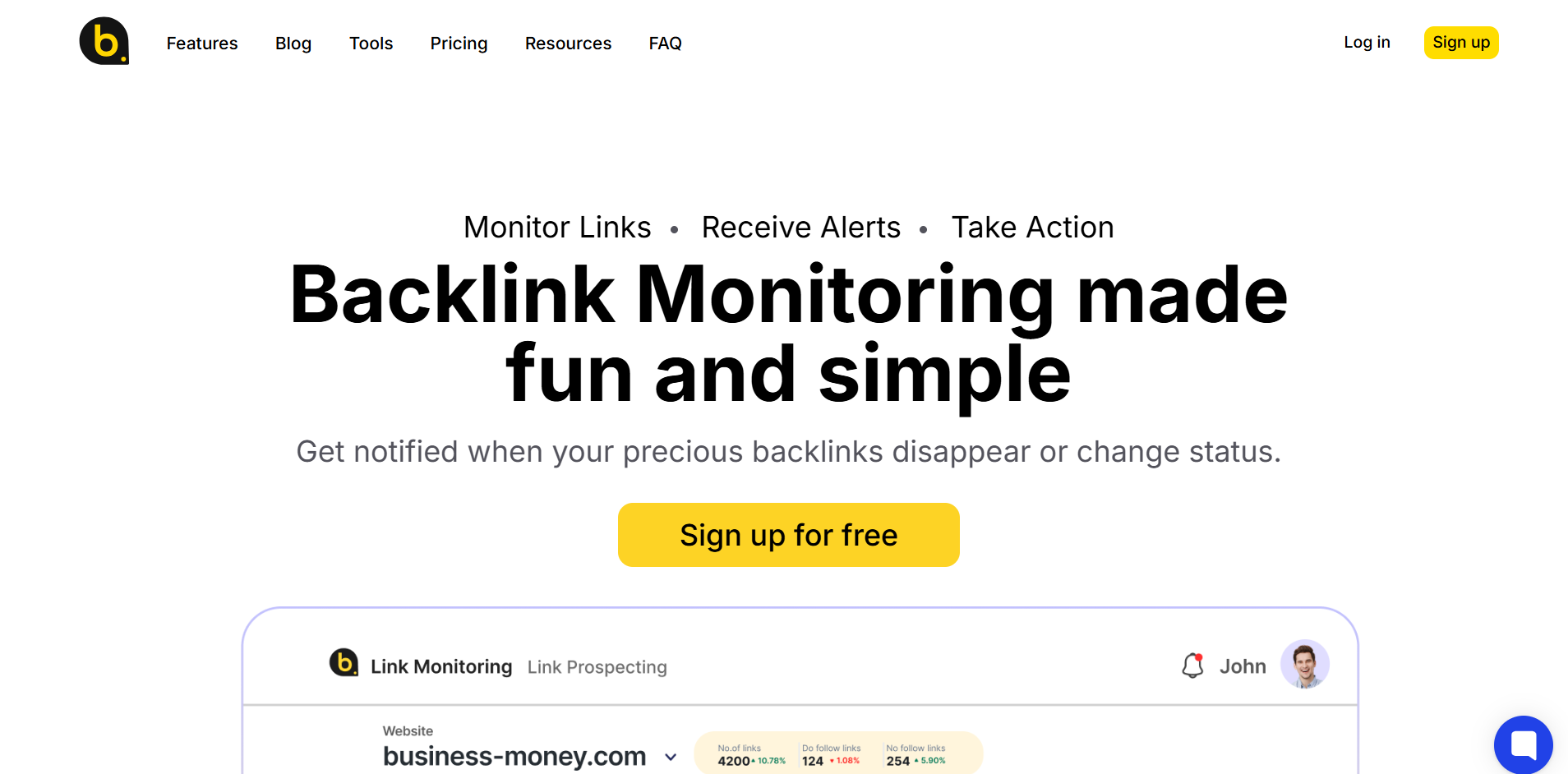
Best for: SEO professionals and agencies looking for backlink monitoring with structured subscription plans.
Pricing: Free for up to 500 backlinks; paid plans start at $9.99/month.
Backlink Monitor is another platform focused on tracking backlinks and helping users manage their link portfolios. It provides backlink monitoring, change notifications, and reporting features.
Its pricing structure is based on the number of domains, monitored backlinks, and users included in each plan.
The Starter plan costs $11.99/month and supports one domain with up to 500 monitored links. The Pro plan costs $29.99/month and supports six domains, 2,000 links, and three users. Higher-tier agency plans offer additional capacity and team access.
Where Backlink Monitor Fits
Consider an SEO freelancer managing backlinks for a single website. They might have 300 acquired placements and want an affordable way to monitor them. Backlink Monitor's entry-level plan could be suitable for that requirement.
For agencies, however, domain limits deserve attention. An agency managing backlinks for ten different clients would need a plan supporting at least ten domains. That makes it important to evaluate the subscription based on the number of client websites, not just the number of backlinks.
What About Real-Time Monitoring?
Backlink Monitor advertises real-time backlink updates. However, the term deserves some clarification.
There is a difference between checking backlinks continuously and sending notifications immediately after detecting a change. A platform may process changes and send alerts quickly while still verifying individual backlinks on a schedule.
Backlink Monitor's public pricing information doesn't clearly establish the exact verification interval behind its real-time messaging. If monitoring frequency is an important purchasing consideration, it's worth confirming this with the provider.
This isn't necessarily a limitation of the product. It's simply information that buyers should understand before subscribing.
Pros
· Dedicated backlink monitoring platform.
· Free plan supporting 20 backlinks.
· Affordable entry-level pricing.
· Email notifications.
· Slack alerts on higher plans.
· Multiple subscription tiers.
· Team access for agencies.
Cons
· Domain limits vary by plan.
· Backlink quotas increase with subscription tiers.
· Slack notifications aren't included in the entry-level plan.
· Exact per-link verification frequency should be confirmed.
Our Verdict
Backlink Monitor is worth considering for freelancers and agencies that want a dedicated backlink tracking platform with predictable subscription tiers. Its lower starting price is attractive for smaller portfolios. However, agencies should calculate their requirements based on both monitored backlinks and client domains.
3. Linkody - Best for Backlink Monitoring With SEO Metrics
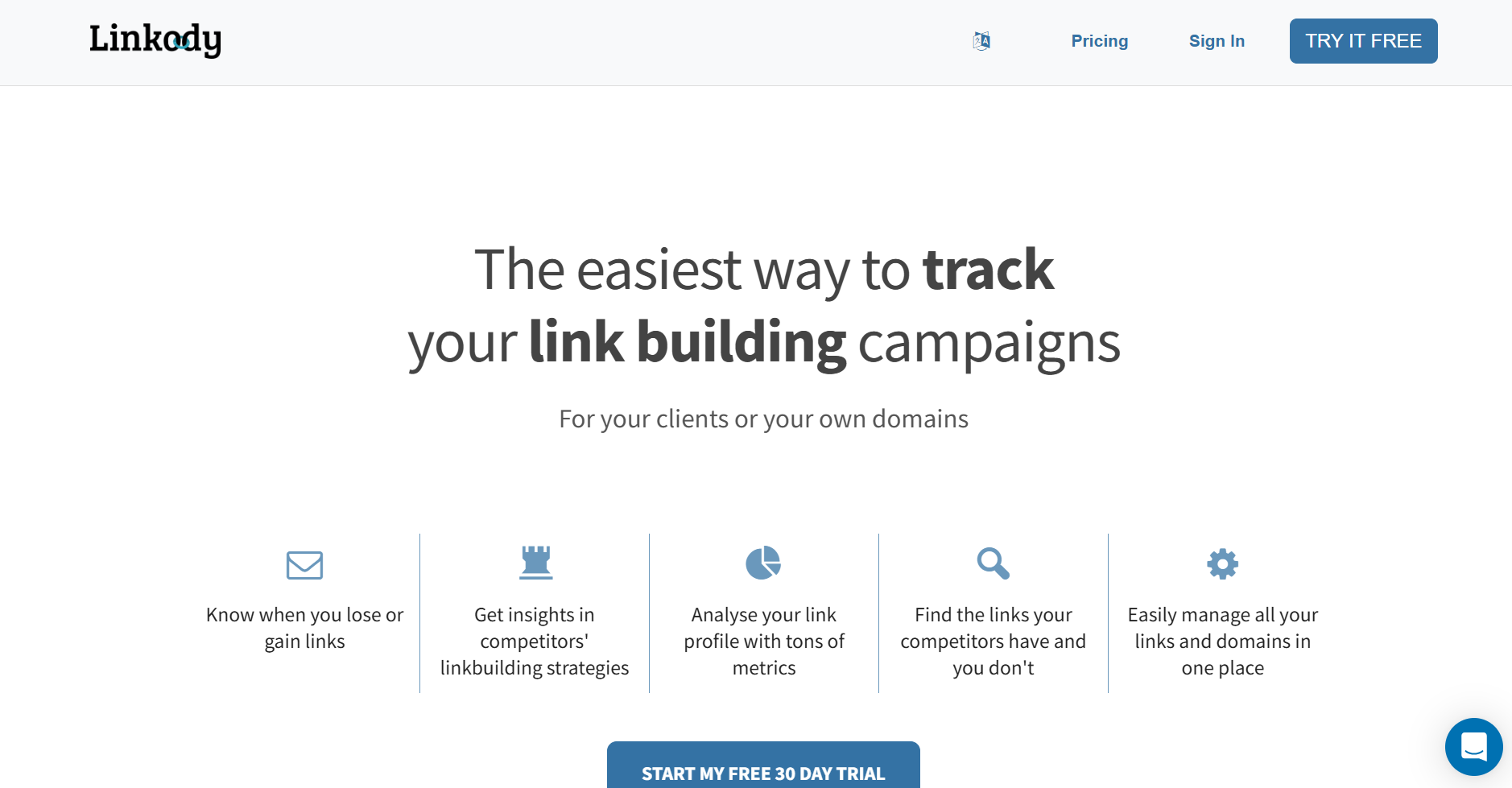
Best for: SEO professionals who want backlink monitoring alongside authority metrics, backlink discovery, and reporting.
Pricing: Starts at $14.90/month for 500 monitored links.
Linkody is an established backlink monitoring platform that combines link tracking with broader backlink analysis. It offers automated backlink checks, email reports, backlink discovery, competitor monitoring, and third-party SEO metrics.
These include Ahrefs Domain Rating, Moz Domain Authority, Spam Score, and other indicators commonly used by SEO professionals.
Unlike monitoring-only tools, Linkody provides additional context about the overall backlink profile. It also allows users to manually add backlinks or import them in bulk.
According to its official documentation, Linkody checks monitored backlinks and updates their status every 24 hours.
Where Linkody Fits
Suppose you're managing link building for a SaaS company. You want to know whether acquired backlinks remain live, but you also want to understand the authority of referring domains and monitor newly discovered backlinks.
Linkody combines these requirements. Its dashboard provides link status information alongside SEO metrics. This can reduce the need to switch between multiple platforms for basic backlink analysis.
For agencies, Linkody also supports PDF reporting, backlink exports, and multi-user access on eligible plans.
Monitoring Frequency
One advantage of Linkody is that its monitoring frequency is clearly documented. It states that backlinks are checked every 24 hours.
This is more useful than vague claims about continuous monitoring because users know what checking interval to expect.
However, daily checks don't guarantee that every backlink change will be detected immediately. If a publisher removes a link shortly after a successful check, the change may not be detected until the next scheduled verification. That's a normal limitation of periodic monitoring.
Where Linkody May Be Less Suitable
Linkody's pricing depends on monitored links, websites, and users. Its $14.90/month Webmaster plan includes 500 monitored links, two websites, and one user. The $24.90/month Advanced plan increases the allowance to 2,000 monitored links and five websites.
Agencies managing larger portfolios may need higher-tier subscriptions. These limits are clearly documented, but they're worth considering when estimating long-term costs.
Pros
· Automatic backlink checks every 24 hours.
· Includes third-party SEO authority metrics.
· Backlink discovery and competitor analysis.
· Daily or weekly email reports.
· Manual backlink additions and imports.
· White-label PDF reporting.
· Link location visualization.
· Multiple subscription tiers.
Cons
· Monitoring limits depend on the subscription.
· Website and user limits may affect agency workflows.
· Some features may be unnecessary for monitoring-only requirements.
· Costs increase as portfolios grow.
Our Verdict
Linkody is a good choice for SEO professionals who want backlink monitoring and backlink analysis in the same platform. It offers more SEO-related functionality than a dedicated placement-monitoring tool. For agencies that already use separate platforms for authority metrics and competitor research, some of these additional features may overlap with their existing subscriptions.
4. Monitolink - Best for Monitoring and Backlink Recovery
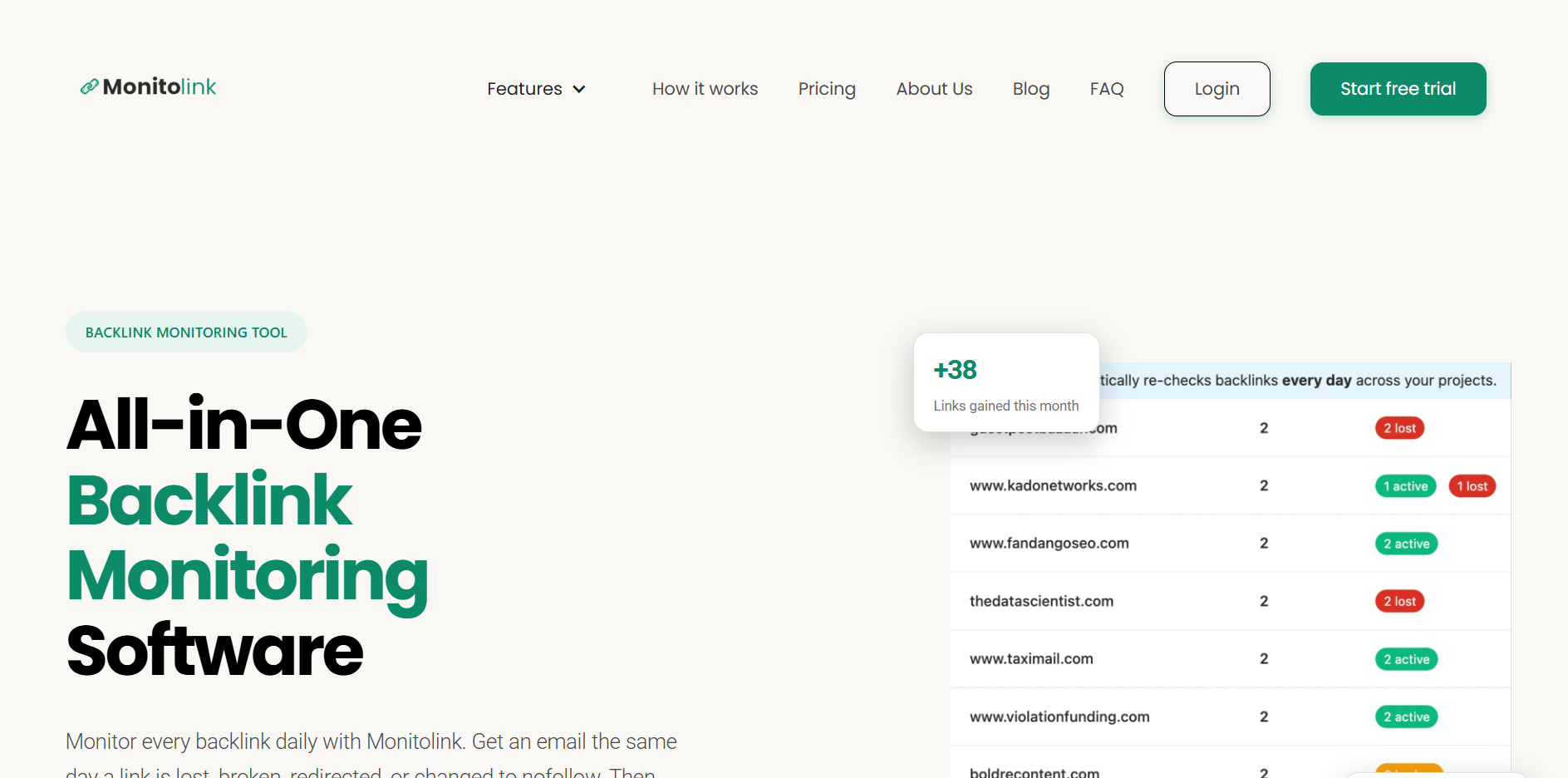
Best for: Agencies and SEO professionals who want to combine backlink monitoring with recovery outreach.
Pricing: Paid plans start at $29/month.
BacklinkMonitoring.ai, also branded as Monitolink, approaches backlink monitoring as part of a broader link-management workflow.
It provides backlink status checks, discovery, competitor monitoring, AI insights, and backlink recovery features.
Its paid plans include daily backlink verification, while the free tier offers weekly checks. The Starter plan costs $29/month and includes three projects and 2,500 monitored backlinks. Higher-tier plans provide additional capacity, team access, integrations, and reporting features.
What Makes Monitolink Interesting?
One of its distinguishing features is backlink recovery outreach.
Imagine you're managing 150 acquired backlinks for a client. During a routine monitoring check, the tool identifies several missing placements.
Normally, the next step would involve finding the publisher's contact information, opening your email account, and requesting restoration.
Monitolink offers features intended to streamline that process. Users can look up publisher contact information and manage recovery outreach through connected email accounts.
For agencies regularly contacting publishers about missing links, this could reduce manual work.
Monitoring and Discovery Are Different Activities
Monitolink also distinguishes between checking existing backlinks and discovering new ones.
Its Starter plan advertises daily backlink status checks and weekly backlink discovery.
These are separate functions. Daily monitoring means revisiting known backlinks to check whether they're still present. Weekly discovery means looking for additional backlinks that may have appeared since the previous crawl.
This distinction is useful because a tool can discover new backlinks frequently without necessarily verifying every known placement at the same frequency.
Where It May Be Less Suitable
Monitolink includes several capabilities beyond backlink monitoring. These include AI insights, competitor research, outreach workflows, and reporting.
For agencies that want these features together, that may be an advantage. However, a link builder who already maintains publisher relationships and only needs to verify existing placements might not require the additional functionality.
Its project limits and backlink allowances should also be considered when choosing a plan.
Pros
· Daily backlink monitoring on paid plans.
· Built-in backlink recovery outreach.
· Publisher contact discovery.
· Competitor monitoring.
· AI-generated insights on eligible plans.
· White-label reporting on agency plans.
· Multiple subscription tiers.
Cons
· Daily monitoring requires a paid plan.
· Projects and monitored backlinks are limited by plan.
· Some advanced features require higher subscriptions.
· Additional functionality may be unnecessary for monitoring-only workflows.
Our Verdict
Monitolink is particularly relevant to agencies that want to combine backlink verification with recovery outreach. Its value lies in connecting the detection of missing backlinks with the process of contacting publishers. For users who already have established outreach workflows, a simpler monitoring-focused platform may be sufficient.
5. Ahrefs and Semrush - Best for Comprehensive Backlink Analysis, Not Just Monitoring
Best for: SEO professionals, agencies, and SaaS businesses that need backlink discovery, competitor research, and comprehensive SEO analysis.
Ahrefs and Semrush deserve a place in this comparison because they're among the most widely used platforms for backlink research.
Both offer extensive backlink analysis capabilities.
However, it's important to understand the difference between analyzing a website's backlink profile and repeatedly verifying a known list of acquired backlinks.
These activities overlap, but they aren't identical.
Where Ahrefs Excels
Ahrefs is particularly valuable for backlink discovery and competitor research.
It helps users analyze referring domains, identify newly discovered and lost backlinks, evaluate backlink profiles, and research competitors' link-building strategies.
For example, suppose you're building backlinks for a project management SaaS company. You want to identify websites linking to competing project management platforms. Ahrefs can help you discover those opportunities.
It can also notify users when backlinks are gained or lost. Its backlink alerts are useful for identifying changes in a domain's backlink profile.
The Difference Between Database Updates and Individual Backlink Checks
Ahrefs maintains a large backlink database that receives frequent updates.
However, that doesn't mean every individual backlink is revisited every few minutes.
According to Ahrefs' own documentation, its live backlink index receives fresh updates every 15–30 minutes, while refreshing the entire database takes approximately two months.
Some pages may be revisited many times during that period, while others may only be revisited once. The frequency depends on the pages involved.
This distinction matters for link builders.
If you've acquired a backlink on a relatively small publisher website, you cannot assume Ahrefs will revisit that exact page within 24 hours.
For general backlink research, variable recrawl frequency is understandable. For monitoring a specific list of paid placements, however, predictable verification intervals can be more useful.
Where Semrush Excels
Semrush provides backlink analysis, backlink auditing, competitor research, and broader SEO functionality.
Its Backlink Audit tool helps users review backlink profiles, identify potentially problematic links, and monitor gained or lost backlinks.
It also integrates with Google Search Console and supports importing backlink lists.
These features make Semrush useful for understanding a website's overall backlink profile.
However, its backlink auditing process also depends on what its crawler can access.
Semrush explicitly explains that certain backlinks may not appear in its audit results if the linking pages are blocked by robots directives or cannot be accessed by its crawler.
It also notes that backlinks wrapped in JavaScript or located on pages that don't return HTTP 200 responses may not be added to audit campaigns.
That brings us to an important limitation affecting backlink monitoring in general.
Why a Backlink Marked as Lost Isn't Always Lost
This is something every link builder should understand before relying on automated backlink monitoring.
A crawler failing to access a page doesn't necessarily mean the backlink has disappeared.
Consider a common situation. You've acquired a backlink on a technology publication. The link has been live for several months. One day, your monitoring tool attempts to access the page but receives an HTTP 403 response. The tool cannot retrieve the article's content.
What should happen next?
A simplistic monitoring workflow might interpret the failed request as evidence that the backlink is missing. But that's not necessarily correct.
The page could still be live and accessible to normal visitors. The problem might be that the website is blocking automated requests.
1. Cloudflare and Bot Protection
Many websites use Cloudflare or similar services to protect themselves against automated traffic. These systems may challenge or block requests that appear to originate from bots. A monitoring tool might receive a 403 response, a challenge page, or another unexpected result. Meanwhile, a human visitor opening the same URL in a browser may see the article and backlink normally. This creates a verification problem. The crawler hasn't confirmed that the backlink is missing. It has only established that it couldn't reliably access the page. Those are two different outcomes.
2. JavaScript-Rendered Content
Some websites render important parts of their content using JavaScript. A basic crawler might retrieve the initial HTML without executing the scripts required to display the complete page. If the backlink appears only after JavaScript execution, the crawler may fail to detect it. Browser-based rendering can help in some situations, although it doesn't guarantee successful verification on every website. This is why the method used to retrieve a page can affect backlink monitoring results.
3. Temporary Server Errors
A publisher website might temporarily return an HTTP 500, 502, or 503 response. These errors can occur because of server problems, maintenance, or temporary infrastructure issues. They don't automatically mean the article has been deleted. If a monitoring tool immediately reports the backlink as permanently missing, it may create unnecessary concern. A more useful approach is to preserve the error information and attempt verification again.
4. Request Timeouts
Sometimes a website simply takes too long to respond. The request times out before the crawler can retrieve the content. This can happen because of slow servers, network conditions, or temporary connectivity issues. Again, a timeout doesn't prove that the backlink is gone. It means the monitoring attempt was unsuccessful.
5. Genuine Page Deletions and Link Removals
Of course, backlinks do disappear. A publisher might delete an article, remove a link during a content update, or change the destination URL. A genuine HTTP 404 response can indicate that the linking page no longer exists at that address. Similarly, if a monitoring tool successfully retrieves the complete article and confirms that the expected backlink is absent, that's stronger evidence of removal. Even then, context matters. The page may have moved to a new URL, or the publisher may have changed its structure. The important thing is to distinguish actual evidence of removal from a failed verification attempt.
What Should a Backlink Monitoring Tool Report?
Ideally, the monitoring results should distinguish between several situations.
| Situation | What it means | Appropriate response |
|---|---|---|
| Backlink verified live | The expected backlink was found | No action required |
| Backlink confirmed missing | The page was accessible, but the expected link wasn't found | Investigate or contact the publisher |
| Page returns 404 | The linking page may have been deleted or moved | Check for redirects or a replacement URL |
| HTTP 403 / Cloudflare challenge | The crawler couldn't reliably access the content | Retry or use another verification method |
| Server error | The website returned an error | Recheck before assuming removal |
| Request timeout | The request didn't complete | Retry verification |
| Anchor or link attribute changed | The backlink exists, but its characteristics changed | Review the agreed placement |
A monitoring tool doesn't need to guarantee perfect verification. No crawler can reliably access every website under every condition. But it should avoid presenting uncertainty as confirmed backlink loss. For agencies managing paid placements, this distinction can prevent unnecessary publisher outreach and misleading client reports.
A Practical Example: When a Backlink Appears Missing but Is Still Live
Let's consider a hypothetical scenario based on a common technical problem in backlink monitoring.
An agency acquires a contextual backlink on a SaaS publication. The placement costs $150. The backlink is verified manually when it goes live.
Its details are: Linking page: SaaS publication article; Destination: Client's product page; Anchor: AI workflow automation; Link type: Dofollow; Acquisition cost: $150; Initial status: Live.
A month later, an automated crawler attempts to revisit the article. Instead of receiving the article's HTML, it encounters a Cloudflare challenge. The monitoring tool cannot determine whether the backlink is still present.
There are two possible ways a system could handle this situation.
Approach A: Treat the unsuccessful crawl as a missing backlink. The agency receives a lost-backlink notification. The link builder opens the article manually and discovers that the backlink is still live. They've spent time investigating an issue that didn't actually exist.
Approach B: Treat the result as an unsuccessful verification. The monitoring system records that the page couldn't be reliably accessed. It attempts additional verification using another supported method. If verification succeeds, it updates the backlink's status based on the retrieved content. If the page remains inaccessible, it preserves the uncertainty rather than automatically claiming the backlink has disappeared.
The second approach provides more useful information.
This is the verification philosophy behind Backlink Vigil's multi-step checking process.
However, this example is illustrative. It isn't evidence that any particular competing tool follows Approach A.
Why This Matters for Agencies
Imagine managing 500 acquired backlinks. Even a small number of incorrect missing-link reports can create unnecessary work. Every questionable result may require someone to open the page, verify the placement, check the anchor, and determine whether publisher outreach is necessary. For agencies, verification quality therefore matters alongside monitoring frequency. A tool that checks frequently but produces confusing results can still create operational problems. The objective isn't simply to detect more missing backlinks. It's to distinguish genuine placement problems from technical verification failures.
Real-World Monitoring Test: How Should You Compare Accuracy?
Feature lists only tell part of the story.
If you're choosing a backlink monitoring tool for a serious link-building operation, it's worth testing how it handles the types of websites you actually work with.
A practical comparison doesn't need hundreds of backlinks. You can start with 10–15 known placements. Choose a mix of ordinary publisher websites and technically challenging pages.
| Test category | What to include | What to evaluate |
|---|---|---|
| Standard HTML pages | Public articles without unusual restrictions | Basic link detection |
| Cloudflare-protected websites | Pages using bot protection | Handling of blocked requests |
| JavaScript-heavy pages | Articles requiring browser rendering | Ability to retrieve rendered content |
| Redirected pages | Articles moved to new URLs | Redirect handling |
| Confirmed removed links | Accessible pages where links were deleted | Missing-link detection |
| Nofollow changes | Links whose attributes were intentionally changed | Link attribute detection |
| Anchor changes | Links with modified anchor text | Change detection |
| Temporary server errors | Pages returning intermittent errors | Error handling and retries |
Before starting, manually verify the expected status of each placement. Then add the same URLs to the tools being compared, where supported.
Record what each tool reports and how long it takes to identify meaningful changes.
For a fair comparison, evaluate not just whether a tool reports a link as missing, but whether it correctly distinguishes missing links from inaccessible pages.
Also record whether a tool's result is based on a recent crawl or previously collected data. This matters because a backlink database might contain an older observation that doesn't reflect the page's current state.
What Would Make the Test Useful?
· Does the tool detect a genuinely removed backlink?
· Does it identify anchor and link attribute changes?
· How does it handle Cloudflare challenges?
· Does it distinguish inaccessible pages from confirmed removals?
· Does it retry unsuccessful checks?
· How frequently does it revisit known placements?
· Does it provide enough historical information to investigate a change?
We haven't conducted a controlled, side-by-side test of all the products in this article, so we aren't assigning comparative accuracy scores. The tools are ranked according to their documented features and suitability for the acquired-backlink monitoring workflow.
Backlink Monitoring for SaaS Founders: Are Your Agency-Delivered Links Still Live?
If you're a SaaS founder outsourcing link building, backlink monitoring deserves particular attention.
Suppose you've hired an agency to acquire 20 backlinks every month. Your average acquisition cost is $150 per backlink. That's $3,000 in monthly link-building expenditure.
Over six months, you've invested $18,000 in acquiring approximately 120 placements.
The agency provides reports containing the publisher URLs, anchor texts, and destination pages. Everything looks fine.
But how many of those backlinks are still live six months later?
Unless someone checks, you don't necessarily know.
This doesn't mean agencies are deliberately delivering poor-quality links. Publishers can remove or modify backlinks independently of the agency that originally secured them. Articles get updated, websites change ownership, content managers/ SEO’s change and content is occasionally deleted. Even a reputable publisher can accidentally remove a backlink during an editorial update.
Why Independent Monitoring Helps
A SaaS founder doesn't necessarily need to become an SEO expert to monitor acquired backlinks. They already have the placement URLs from their agency reports. Those URLs can be added to a dedicated monitoring tool.
From there, automated checks can help identify whether placements remain intact.
This provides an additional layer of visibility into the company's link-building investment.
It also creates a more productive conversation with the agency. Instead of asking whether a campaign delivered 20 backlinks, the founder can ask whether those placements remain live and whether any need attention.
Monitoring Isn't the Same as Guaranteeing Rankings
It's worth keeping expectations realistic.
A live backlink doesn't guarantee higher Google rankings. Search performance depends on many factors, including content quality, relevance, competition, technical SEO, and Google's evaluation of links.
Likewise, losing one backlink doesn't automatically cause a ranking decline.
Backlink monitoring serves a narrower purpose. It helps businesses understand whether acquired placements remain present and whether their characteristics have changed.
That's valuable even when the direct ranking impact of an individual backlink cannot be measured.
Backlink Monitoring for Link-Building Agencies: What Happens After Delivery?
For agencies, backlink monitoring can become part of campaign quality assurance.
Most link-building workflows focus heavily on acquisition. Teams spend time prospecting websites, negotiating placements, preparing content, coordinating publication, and verifying that links go live.
Once a placement is delivered, the workflow often ends.
But a backlink's publication date shouldn't necessarily be the last time anyone checks it.
Consider a Typical Agency Workflow
An agency manages five SaaS clients. Each client receives 15 backlinks monthly. That's 75 new placements every month.
After six months, the agency has delivered 450 backlinks.
Manually revisiting all 450 placements would take considerable time. And the portfolio continues growing.
Automated monitoring makes this process more manageable.
Instead of checking every link manually, the team can focus on placements that have changed or require investigation.
For example, a weekly review might identify: Three confirmed missing backlinks. Two anchor-text changes. One dofollow-to-nofollow change. Four pages that couldn't be reliably verified.
These situations require different actions. Confirmed removals may justify contacting publishers. Anchor changes may need to be compared against the original agreement. Unverifiable pages may simply require additional checks.
Treating all of them as lost backlinks would create unnecessary work.
Why Historical Records Matter
Agencies also benefit from knowing when changes occurred.
Suppose a client reports that a backlink is missing. Without monitoring history, the agency may need to reconstruct when the placement disappeared.
With historical records, the team can review the last successful verification and the first detected issue.
This doesn't necessarily establish the exact moment the publisher removed the link, but it narrows the investigation.
It can also help agencies document restoration efforts and demonstrate ongoing campaign management.
Should You Use a Dedicated Backlink Monitoring Tool or Ahrefs/Semrush?
For many SEO teams, the answer isn't necessarily one or the other.
These platforms solve overlapping but different problems.
Question 1: What websites link to my competitors, and where can I acquire similar backlinks?
This is a backlink research problem. Ahrefs and Semrush are well suited to this type of work. They provide large backlink databases, competitor analysis, referring-domain metrics, and broader SEO insights.
Question 2: These are the 300 backlinks I've acquired for my clients. Are they still live, and have their anchors or link attributes changed?
This is an acquired-backlink monitoring problem.
A dedicated monitoring tool is designed around repeatedly verifying a known list of placements.
The distinction becomes especially relevant when dealing with websites that are difficult to crawl.
Ahrefs and Semrush have sophisticated crawling infrastructure, but their backlink databases still depend on successful discovery and retrieval.
Neither limitation makes these platforms unsuitable for SEO. It simply reinforces the importance of understanding what each tool is designed to accomplish.
For an agency already using Ahrefs for prospecting and competitor research, adding a dedicated backlink monitor can complement its existing workflow.
You don't necessarily need to replace one with the other.
How Often Should You Monitor Acquired Backlinks?
For most active link-building campaigns, daily monitoring is a reasonable starting point.
It provides regular visibility without requiring constant manual checks.
However, the ideal frequency depends on the type of placements being monitored.
A backlink on a frequently updated news website may change more often than one on a relatively static resource page.
Similarly, agencies managing paid editorial placements may want more frequent verification than website owners casually reviewing their backlink profiles.
The important thing is consistency.
A backlink checked today might disappear tomorrow. If your monitoring tool only revisits it after several weeks, you won't know about the change until then.
Daily checks shorten that potential detection window.
However, daily monitoring should not be confused with real-time monitoring.
A daily monitoring system typically checks a backlink approximately once per day. A change occurring between checks will usually be detected during a subsequent verification.
Some tools may offer manual rechecks or different monitoring schedules.
Before subscribing, verify the actual per-link checking frequency rather than relying exclusively on marketing terminology.
Frequently Asked Questions About Backlink Monitoring Tools
What is the best backlink monitoring tool?
The best backlink monitoring tool depends on what you need to monitor. For users focused on acquired backlinks, Backlink Vigil offers daily checks, multi-step verification, change history, and project-based organization. Linkody is suitable for users who want monitoring alongside SEO authority metrics. Monitolink is worth considering for agencies that want integrated recovery outreach. Ahrefs and Semrush are stronger choices when backlink research and competitor analysis are also major requirements.
Can backlink monitoring tools detect removed backlinks?
Yes. Backlink monitoring tools can revisit linking pages and check whether expected backlinks are still present. However, their ability to confirm removal depends on successfully accessing and interpreting the page. If a website blocks automated requests, a tool may be unable to verify the backlink. An unsuccessful crawl should not automatically be interpreted as confirmed removal.
Can Cloudflare affect backlink monitoring?
Yes. Cloudflare and other bot-protection systems can restrict automated crawlers. A monitoring tool may receive a challenge page or HTTP 403 response instead of the article containing the backlink. This doesn't necessarily mean the backlink has disappeared. Tools using additional verification methods may be better equipped to investigate some of these situations, although no method guarantees access to every protected website.
How often should backlinks be checked?
Daily checks are a practical choice for businesses actively investing in link building. They provide regular visibility into removals and changes. However, the appropriate frequency depends on campaign requirements, monitoring costs, and the importance of individual placements.
Can Ahrefs and Semrush monitor lost backlinks?
Yes. Both platforms provide backlink monitoring and reporting features. Ahrefs offers alerts for gained and lost backlinks, while Semrush provides backlink auditing and lost-link reporting. However, their broader backlink analysis workflows differ from tools focused specifically on verifying a predefined list of acquired placements.
Should SaaS founders monitor backlinks delivered by agencies?
Yes, particularly when link building represents a meaningful marketing expense. Monitoring allows SaaS companies to check whether delivered placements remain live and whether their anchors or link attributes have changed. It also provides historical records that can help when discussing missing placements with agencies or freelancers.
Does losing a backlink automatically hurt SEO rankings?
No. Losing a backlink doesn't automatically cause rankings to decline. The impact depends on the backlink's relevance, authority, quality, Google's evaluation of it, and numerous other ranking factors. Monitoring helps identify placement changes, but it doesn't establish the exact SEO impact of an individual backlink.
Can backlink monitoring tools detect nofollow changes?
Some tools can. Backlink Vigil, for example, monitors link attributes and can detect changes between dofollow, nofollow, and other supported attributes. This is useful when a publisher changes the characteristics of an existing placement.
Final Verdict: Which Backlink Monitoring Tool Should You Choose?
The right backlink monitoring tool depends on what you're trying to accomplish.
If your primary objective is discovering backlinks, evaluating referring domains, or researching competitors, Ahrefs and Semrush provide capabilities that dedicated monitoring tools aren't intended to replace.
If you want backlink monitoring combined with SEO metrics, Linkody is a practical option.
Backlink Monitor offers a dedicated tracking platform with structured plans for different portfolio sizes.
Monitolink is particularly interesting for agencies that want to connect monitoring with publisher outreach and link recovery.
And if your priority is monitoring backlinks you've already acquired, Backlink Vigil is built specifically for that workflow.
Its daily checks, multi-step verification, handling of unverifiable pages, detailed change history, and project organization address common operational requirements faced by link builders and agencies.
But regardless of which platform you choose, the underlying principle remains the same.
A backlink going live shouldn't be the end of your link-building workflow.
Publishers update content. Websites change. Links disappear, anchors get modified, and previously accessible pages sometimes become difficult to crawl.
For agencies, monitoring helps maintain visibility into delivered placements. For SaaS founders, it provides an additional way to oversee link-building investments. And for individual link builders, it reduces the need to revisit every acquired backlink manually.
The goal isn't to collect the largest possible number of backlink metrics.
It's to answer a much simpler question:
Are the backlinks you worked to acquire still there, and are they still the placements you originally secured?
That's what effective backlink monitoring should help you determine.
Automatic daily checks, change history, and alerts for important backlink changes.
Explore Backlink Vigil →